(reposting a little ditty from the archives: this was a presentation for wichita art museum’s now defunct ‘art chatter’ series way back in 2017)
science is the only religion of the future
–francois raspail
in the future, supposing that we have a future, if the future exists in the first place, and isn’t merely a neat grammatical trick, if the future is anything other than an impulse, a drive towards something by its very definition out of reach, we’ll at least have science.
there will be no humans. we will have surpassed ourselves, become woven into the apparently inexorable event horizon of the singularity. the gaping maw of fate. it is progress, the scientists tell us even now. to evolve is human, to upload is divine. we will not recognize where we are going.
the singularity, according to vinge, is that ‘intellectual transition as impenetrable as the knotted space-time at the center of a black hole’ marking the moment the world passes ‘far beyond our understanding’. we will have broken nature down into its constituent parts and rebuilt it into an ‘intelligence far greater than our own’, and in doing so, eliminated ourselves.
if science is the religion of the future, it is a curious religion that consists totally of eschatology, a religion that believes only in its own death, devoid of resurrection. in this, the futurists of science resemble the futurists of art—marinetti, who cried ‘why should we look back when what we want is to break down the mysterious doors of the impossible?’
it is progress, it is the lockstep drumbeat, the process of elimination of fates as the pieces are methodically removed from the board, the possibilities dwindled and the end, an obviously rational outcome, drawing near. despite invocations of quantum physics and string theories, we never really left newton and his mechanics.
or maybe order looks to coopt disorder, and the fuzzy logic of the ether is yet another bridle on chaos. the chemist cyril hinshelwood celebrated science as ‘seeking truth in a world of mystery’, as if the two were somehow separate, and here, we turn, suggesting that this quest for order is rather more like seeking chaff in a field of wheat.
where the scientific method may be otherwise innocuous, it still leads to the scientific ideology and the desire to rend dead facts from mystery. discernment dampens ecstasy, in the formal sense; there is a difference between discovery and revelation, perhaps the same difference as between conquest and wandering.
modern thought prefers what foucault termed ‘subdivision and pyramidal hierarchization’—learning to code is code for learning to divide, to practice the taxonomical mantras of the singularity, arranging nouns in order of material usefulness, verbs become linear vectors rather than ancient resonances. but to conjugate is to subjugate, and the empire of science is ever-expanding.
where science claims to discern order from natural investigations, in many ways it imposes it, giving names when, as the tao te ching says, the name you can say isn’t the real name. but what use do computers have for monasteries?
the propagandists of the enlightenment have done well to convince us this was all preordained, an evolutionary process as orderly and common sense as linnaeus’ kingdoms of phylum and genus, but everything is always happening all at once; all things iterate into all other things non-sensically, and the truth is, we’ve known about this forever.
an example from the time before enlightenment: mennochio, the 16th century miller, who determined for himself that the universe was tenuous order born from diffuse chaos, like ‘cheese from milk’ and angels and humans spontaneously appearing as worms in the cheese. his theology placed god as merely an actor within a general flow of space-time, so of course, he was burned at the stake.
the dutch painter, hieronymous bosch, predates mennochio by half a century, but may have been sympathetic to the miller’s preference for the fluid form. bosch paints in terrifying frenzies, everything is intermingled and relational and in transition, forms are hybrid or in palimpsest, bearing the marks of multiple iterations.
the preference of nature is in lateral associations, horizontal relationships as opposed to vertical hierarchies—what the french philosophers deleuze and guattari termed ‘rhizomatic’: ‘a rhizome has no beginning or end, it is always in the middle, between things, inter-being, intermezzo’.
isn’t the structure of the universe itself rhizomatic, infinite and tangled? where is the hierarchy of association here, or the innate preference of direction? in a universe like ours, everywhere is up, there is as much nothingness above as below, no matter where you go, there you are. the kingdom is all around you.
art not only follows from this meandering structure, it depends on it. the artist is a conduit of the non-rational, ever engaged in the pursuit of the unknowable. there is a distinction here: the scientist pursues the unknown to make it known, whereas the artist seeks the unknowable in order to revel in it.
against the orthodoxy of the laboratory we must make a case for art, on its own, which is finally, a case for the wilderness, unkempt and unnamed. wilderness is a rhizome, always fluctuating between locations, between forms and timespaces. if it can be described, it can be programmed and co-opted, so we must take great care to remain indescribable and beyond comprehension.
where will this leave us, to be beyond comprehension and not knowing? meaning comes from the void, condensing onto reality like dew on grass. you cannot engineer your way to salvation. science cannot save you, it can only tell you how you are going to die. art will tell you why.
to find meaning is to wander the wilderness, to navigate flows and encourage multiplicity. we began with singularity, the hyperfocus of science into its own collapse. we’ll end in the middle, diffuse and omnipresent, everything is happening all at once.
if you want to live, to be human, you must practice being wild, being rhizomatic. power loves facts. facts are easily weaponized. the atom is a fact. genes and oil are facts. for every life saved by a vaccine, a hundred more were taken by a bullet. every fascism is the result of a deforestation of the wilderness.
what’s the hurry? where are you going? the future will not arrive any faster if you chase after it. the tree of knowledge is just one tree among many in the garden, all bearing fruit faster than we can eat it. stay a while, tell your stories and lies. our favorite part is the middle, where everything is still possible and nothing is mistaken for truth.
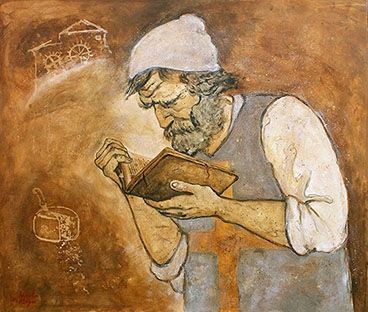
 concept machine
Leave a comment