the graffiti writer sees the world as a field of surfaces. an architect designs the exterior of a building to communicate the interior function; the graffiti writer paints an exterior in order to match the surface of the building to its situation.
writing on the surface of a building is an imposition on and disruption of the ability of the building to fulfill its purpose. the graffiti immediately hijacks the order of the straight lines and square angles, interrupting it with a feral geometry: something wild happened here–these marks are the remainder, like the scorched earth after a fire.
that the graffiti writer interrupts the normal or status quo functioning of public space and private structures is easy enough to see in simple isolation: a mailbox becomes a canvas, no longer first of all a mailbox. the same basic refiguring happens to lampposts, windows, walls…
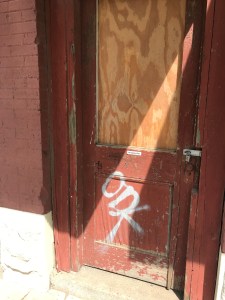
doors of all kinds offer opportunities for graffiti writers to appropriate the surface in different ways than walls or city infrastructure. a doorway is often recessed, providing cover and safety for a writer to leave behind a quick tag or inscription. on the other hand, doorways are definitionally areas where encountering other people is highly likely: along with safety, doorways increase risk of capture.
a door is a portal, but for the writer the door is a moment in time, a stop along the way. buildings are not made of exteriors and interiors, but for the graffiti writer, the inside of a building is simply another field of exteriors, more potential surfaces. there is no entering or exiting a building when you write graffiti, instead graffiti prioritizes the temporal qualities of movement over the physical: how long a night of writing will last, how quickly a piece can be put up, the pace of the walk between spots, the internal pressure of the paint in a spray can determining the speed at which it runs out.
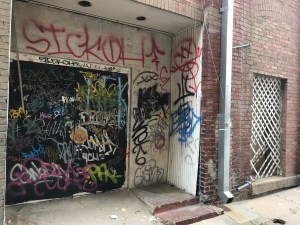
certain spots become archives for writers. recessed alley doors seem particularly prone to this type of appropriation, perhaps because the surface is often more amendable to the types of grease pens and paint markers that writers like for quick tags, over the brick or concrete surfaces of buildings that are better suited for paint. over time, the tags and gestural images accumulate, and a small gallery is aggregated featuring writers and artists from across the city and throughout time. each tag makes up part of the contrail of a writer’s walk through the city. through observation of small details like paint color or handstyle, a perceptive investigator might be able to retrace a single night’s journey. even drip quality may indicate the particular weather conditions of a night out bombing the city.
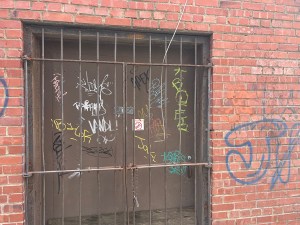
civic art infrastructure projects like downtown wichita’s “alley doors” attempts to cordon off the surfaces most identified with graffiti writers and put them into a kind of stasis. by applying vinyl renderings of artwork to alley doors, the eco-dev cabal hopes to make illegal writing less palatable to vandals, but it’s a curious battle: a territorial dispute over territory that no one but the graffiti writers really wanted in the first place, and until downtown wichita turned its focus to alley doors, most people may not have even considered these alleys as contested in the first place.
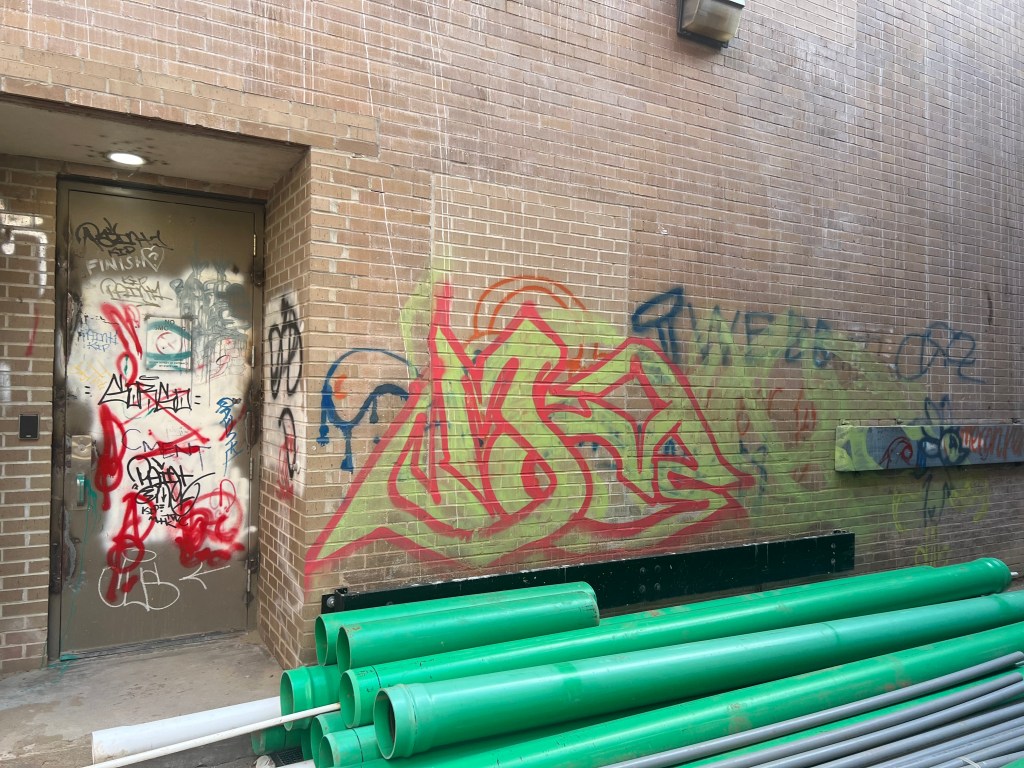
it’s also a territorial dispute that official institutions are unlikely to win. for our authorities, all space, whether interior or exterior, alley or street-side, are limited by their stated function. the graffiti writer sees no such limitations, only an expansive surface, porous and in need of paint. the graffiti writer is therefore always more perceptive and attuned to the capacities of space and time in a city, and may be among the only people capable of actually living in a city in its actuality, beyond the limits prescribed by politicians or police.

 concept machine
Leave a comment